
Charleston City Directory Holdings
Three repositories divide the Charleston city directory run. The WV Archives year list supplies the longest dated spine. The Kanawha County Public Library Polk collection extends from 1908 to the present as an in-library resource. The WVU Regional History Center list provides a second microfilm route through 1988. Each access channel matters because the series overlap but are not identical.
| Collection | Years | Where held | Access |
|---|---|---|---|
| Charleston directory run | 1874–75 through 2012–16, with many gaps | WV Archives | Year list, library use, written research/copy request |
| Polk's Charleston directories | 1908–present statement | KCPL Main Library, third floor | In library only; no checkout or holds |
| Charleston microfilm | 1906–52; 1954–88 in segments | WVU Regional History Center | Ask for the reel and issue matching the date |
| West Virginia gazetteers | 1877 through 1923–24 in listed runs | WV Archives | Town, official, and business context |
| Newspaper archive | Varies by title | KCPL | In-library database and reference help |
The collections should not be merged into a claim of annual coverage. The Archives has early and late gaps, the library's “present” statement does not promise every yearly volume, and WVU describes segmented reels.
Charleston Directories Begin in 1874
The Archives lists Charleston volumes for 1874–75, 1883–84, 1888–90, 1893–96, 1899, 1901, 1903–07, 1909, 1913–15, 1917–18, 1920, 1922, 1932, and selected years through 1952. Its strongest continuous stretch is 1954–2000, followed by 2004, 2007–08, 2010, and 2012–16. Missing dates must stay missing.
The official year-list capture lets a reader check whether a target year belongs to the Charleston city directory shelf.
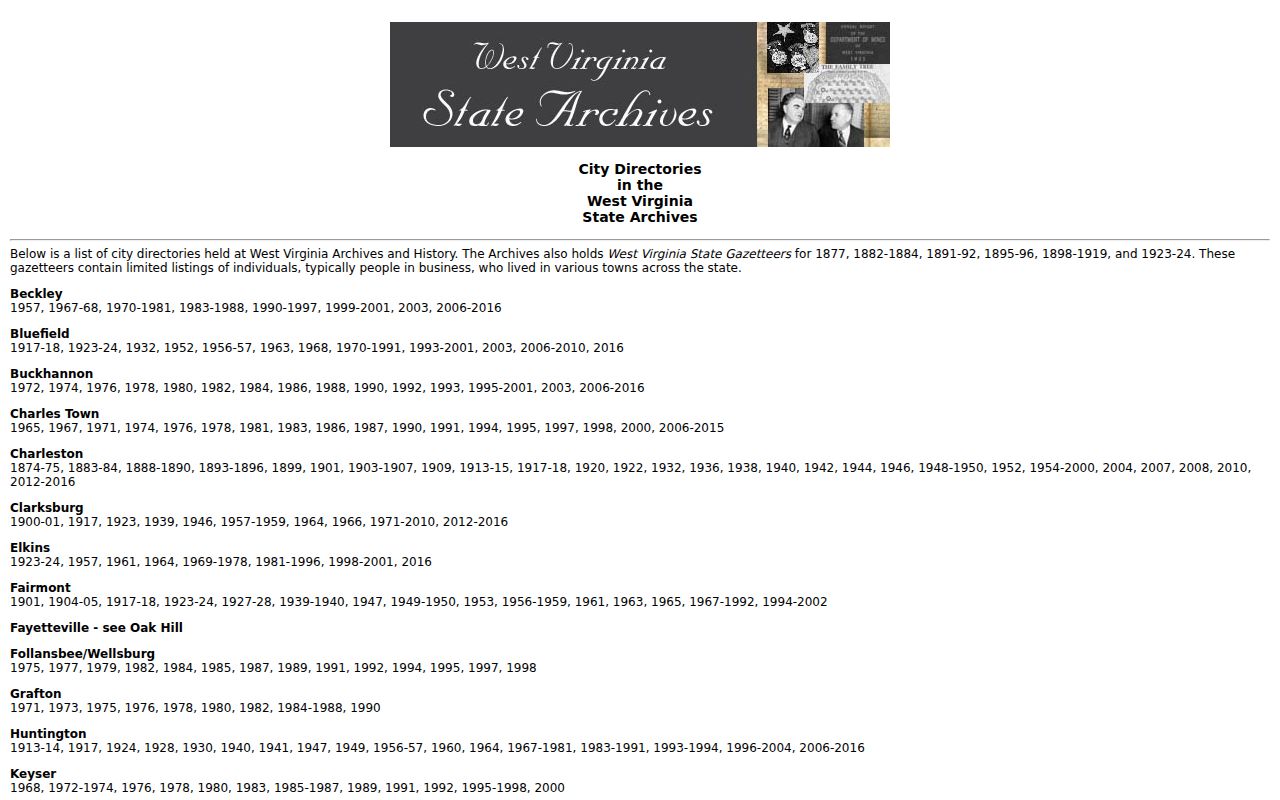
The screen is a holdings guide, not a full-text resident search. Record the exact year before contacting the Archives so staff can route the request to the right volume.
Note: A gap in the online year list is not proof that the underlying Kanawha record was destroyed.
Read Charleston Polk Volumes
KCPL describes Polk's Charleston City Directories as personal and business address books covering Charleston and suburbs from 1908 to the present. The volumes are on the third floor of the Main Library at 123 Capitol Street. They cannot be checked out or placed on hold, and the library does not describe the full run as remotely searchable.
The KCPL Local History and Genealogy page also links obituary requests, an in-library newspaper archive, West Virginia vital research records, and WVU images. Reference staff can be reached at 304-343-4646 or Reference@KanawhaLibrary.org. Main Library hours are Monday through Thursday, 9 a.m. to 8 p.m., and Friday and Saturday, 9 a.m. to 5 p.m.; the third floor closes 15 minutes early. Scanning is free and printing or copying is $0.20 per page.
The library capture shows the local-history doorway used with the Charleston city directory shelf.
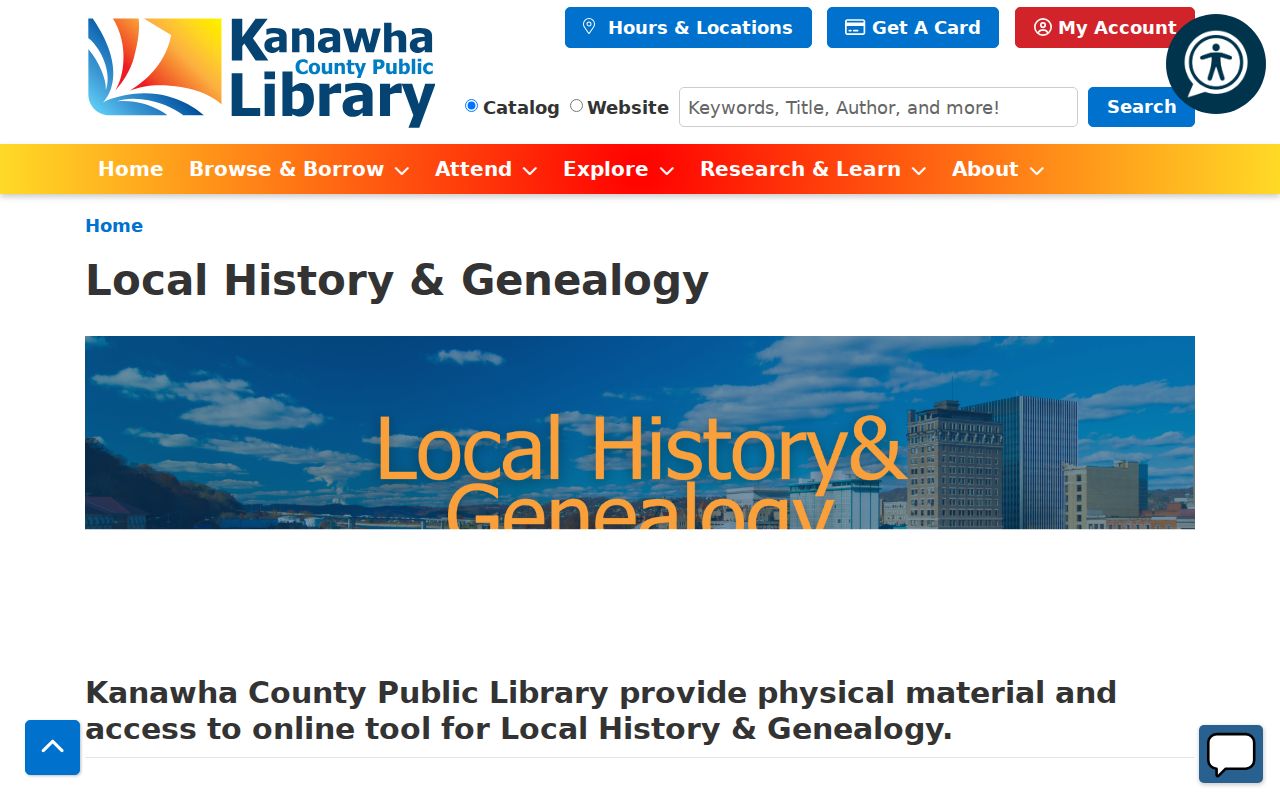
This route is most useful when a citation needs a scan, an obituary lead, or help finding the right printed volume.
Fill Charleston Years With WVU
WVU's microfilm inventory lists Charleston directories for 1906–52, 1954–63, 1964–68, 1969–78, April 1978 through April 1980, April 1981 through April 1983, and April 1984 through March 1988. The month labels matter. Ask reading-room staff which reel and issue matches the date instead of assuming that one reel equals one calendar year.
The WVU microfilm capture provides the alternate catalog for a Charleston city directory search.
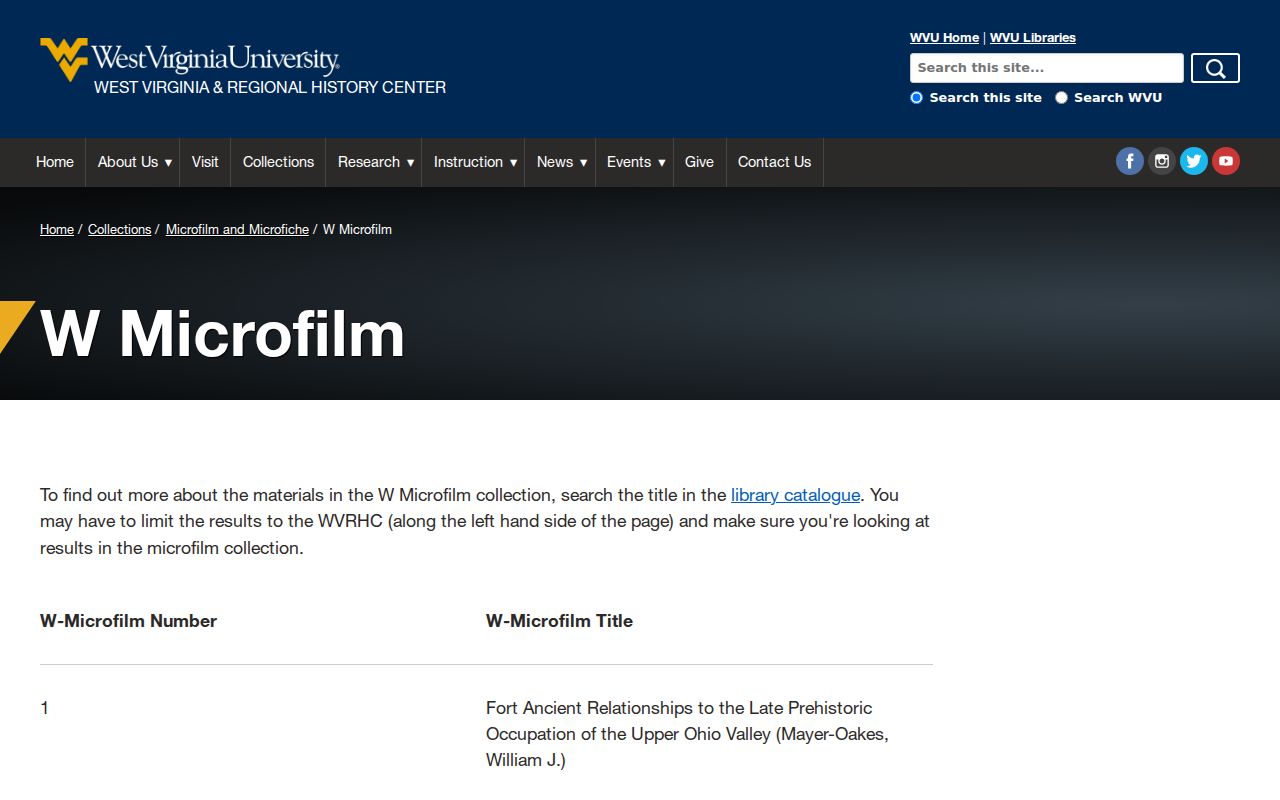
Use WVU to check a year that is awkward or absent elsewhere, then retain the reel, issue, page, and repository in the citation. A second image of the same entry can also clarify blurred type or an index error.
Read a Charleston Directory Entry
A Charleston city directory entry is dense shorthand. Copy it as printed before interpreting it. Capture the surname, given name or initials, spouse or household mark, occupation, employer or business, street address, phone, and any cross-reference. Then photograph or transcribe the abbreviation key from that same volume. The official holdings pages do not expose a verified sample Charleston entry, so no local abbreviation should be expanded from guesswork.
| Name | Exact spelling, initials, variants, and any “see” reference |
|---|---|
| Household | Spouse, widow, or other relation only when the printed key supports it |
| Work line | Occupation, employer, office, or business when printed |
| Address | House number and street, identified as home or business if the key says so |
| Publication detail | Volume, year, publisher or imprint, page, reel, and repository |
- Criss-cross directory
- A section ordered by street address or phone instead of by surname.
- Householder index
- An address-ordered list that may name the person associated with a dwelling.
- Abbreviation key
- The volume's own legend for its shortened terms and symbols.
No official source confirmed a local reverse-directory run. Inspect the chosen volume or ask staff whether an address section exists before promising one.
Trace Charleston Families by Year
A directory line becomes more useful when it is followed across time. Start with the closest known year, then move to the preceding and following available books. Changes in initials, spelling, work, spouse notation, and address can distinguish two people with the same name.
- Record the first Charleston entry exactly, including the volume, year, page, and repository.
- Check the same surname and address in the nearest earlier and later available volumes.
- Test variant spellings and initials, then inspect an address-ordered section only if that volume has one.
- Pair the line with a released 1910–1950 federal census when the date fits the 72-year rule.
- Use an obituary, vital index, probate file, or deed to confirm a move, death, relationship, or ownership question.
A disappearance has several possible causes: a move, death, skipped directory year, changed street number, spelling shift, or decision not to be listed. One blank year is not a final answer.
Map 1884 Charleston Addresses
The Library of Congress Sanborn item is a three-sheet Charleston map dated January 1884. It can show the form and use of a building, street or lot context, and nearby structures. It does not identify residents. Pair it with an 1883–84 Charleston city directory entry to test whether a named street and mapped structure align.
This is especially useful in the East End, whose historic district contains about 400 buildings and entered the National Register in April 1978. River, rail, salt-industry growth, and later urban renewal changed portions of Charleston's street fabric. A modern parcel may not look like an old block. The map can explain that break, but a deed or plat must carry the legal chain.
Note: Treat a Sanborn sheet as building context, never as proof that a named person occupied the mapped structure.
Confirm Charleston Directory Clues
Directories identify a printed association between a name and address at one point in time. They do not prove ownership. The Kanawha deed indexes, probate books, vital indexes, and census schedules answer other parts of the identity question. WV Archives lists deeds from 1790–1910, wills from 1820–1968, marriages from 1794–1967, births and deaths from 1853–1967, and fiduciary settlements from 1871–1968.
KCPL's obituary form and newspaper archive can add a spouse, child, former residence, cemetery, or funeral home. Obituaries are family-supplied secondary sources, so verify the fact through the West Virginia Vital Research Records, a probate record, or the proper certificate office. Historical index images are not certified copies.
The research chain is strongest when each citation retains its date and keeper. A directory occupant, parcel owner, voter registrant, probate heir, and certificate subject may be different people who share a name.
Charleston Records Survived the Fires
A common local myth says a courthouse fire erased Kanawha County records. The WV Archives history note says the Kanawha courthouse never burned and county records were not lost. Charleston did have statehouse and temporary-capitol fires in 1921 and 1927, but those stories concern state offices and records, not a blanket loss of county deeds or vital books.
That distinction changes the search. When a Charleston city directory scan is absent, check the stated repository and adjacent years. When a deed or marriage item is not online, consult the Archives series description and county record room before calling it lost. The survival of identified court books from 1788–1803 and deeds from 1790 makes Kanawha's paper trail unusually deep.
The West Virginia Historical Society page offers an additional local-history contact and publication route.
The Society is a context source rather than a searchable resident shelf, while Archives, KCPL, and WVU remain the defined directory access points.