
Charleston Previous Resident Sources
No single Charleston record lists every person who occupied a home. The modern assessor record fixes the parcel and current owner, recorded deeds establish transfers, and directories or census schedules add the household layer. Kanawha County has an unusually long paper trail, but its parts sit in different places. Current tax search fields are online when the system is available. Old land books, deed books, city directories, and census sources may require a library visit or a written Archives request.
| Charleston source | Years located | Custodian | Best evidence |
|---|---|---|---|
| Assessor land books | 1791-1962 online viewer; later years being scanned | Kanawha County Assessor | Taxed owner, parcel, acreage, and value |
| Deeds and indexes | Deeds 1790-1910; grantor index 1790-1946; grantee index 1795-1967 at Archives | County record room and WV Archives | Transfer parties and legal description |
| Charleston directories | 1874-75 onward with gaps | WV Archives, KCPL, and WVU | Names and addresses printed for a given year |
| Polk directories | 1908-present statement | KCPL Main Library | Personal and business address listings |
| Federal census | Individual schedules released after 72 years | Federal archives and library databases | Household members on the census date |
| Sanborn map | January 1884, three sheets | Library of Congress | Building footprint and use, not names |
For a twentieth-century question, compare adjacent directory years first, then use deeds to identify the title holder. For an early property, the legal description matters more than the modern street number. No official citywide reverse-directory run or universal renumbering crosswalk was located, so a failed address search does not mean the record is gone.
Fix the Charleston Parcel First
Begin the previous residents search with the complete E-911 street address. The WV IAS Real Property Search accepts an owner, parcel, street address, book and page, class, ZIP, and tax year. Record the parcel ID, map, legal description, property or situs address, mailing address, and owner exactly as shown. Situs means the physical property location. A mailing address is where tax mail goes, and it may be elsewhere.
The county assessor also links a GIS viewer and map card. Those maps are made for assessment from deeds and surveys. They are not legal surveys. Use the parcel outline to identify nearby lots and a likely subdivision, but use the deed or plat for title and boundary questions. The IAS search showed a maintenance notice during the September 2026 inspection, so the assessor at 304-357-0250 and real-estate desk at 304-357-0256 are essential fallbacks.
Open the Kanawha County Assessor data inquiry shown in the Charleston previous residents capture.
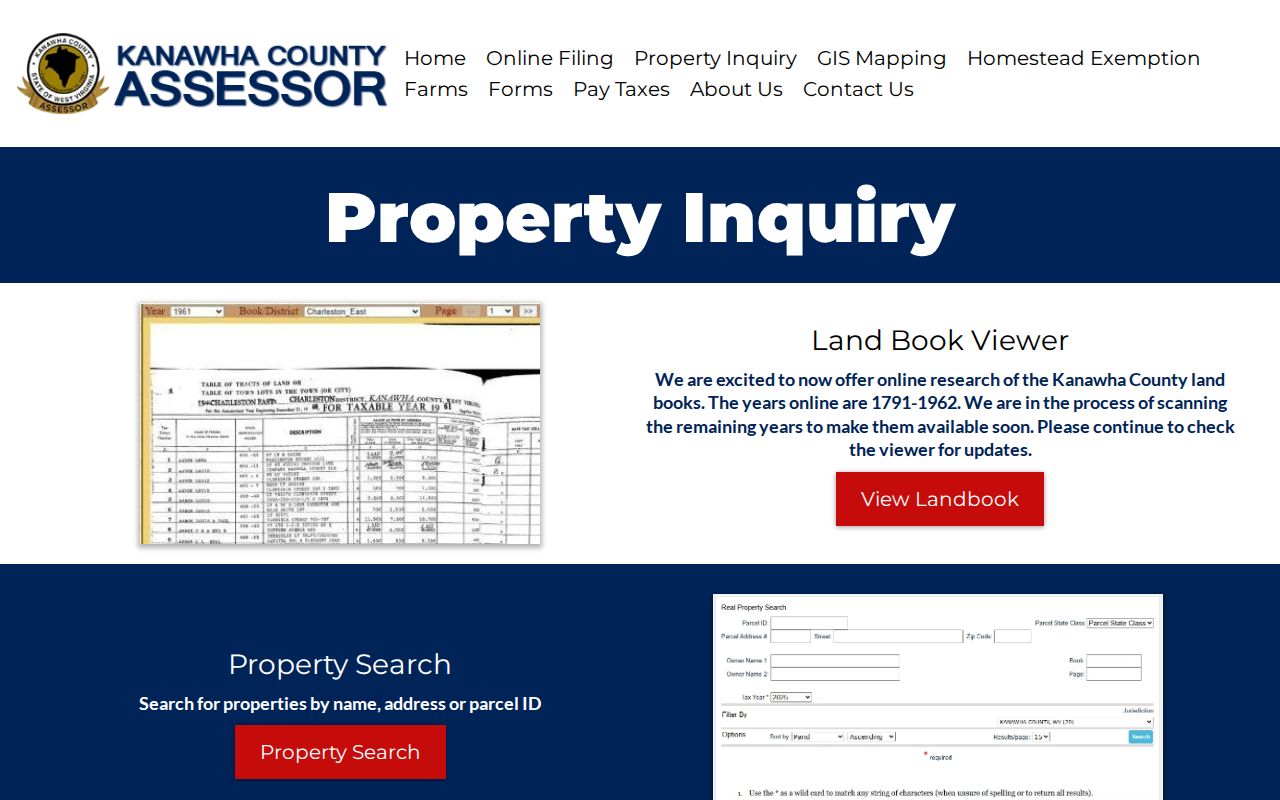
The inquiry page links current parcel tools with historic land books, making it the bridge between a modern address and older tax entries.
Kanawha's Long Records Bridge
WV Archives gives Charleston previous residents research a rare bridge across title and family sources. Its Kanawha guide lists deeds from 1790 through 1910, grantor indexes from 1790 through 1946, and grantee indexes from 1795 through 1967. Related series include marriages from 1794, wills from 1820, births and deaths from 1853, and fiduciary settlements from 1871. These are distinct series, not one continuous web database.
Archives research requests must be made in writing. Staff research is limited to one-half hour and costs $10 for an in-state request or $20 for an out-of-state request. Listed copy requests include $5 in-state and $8 out-of-state charges for an uncertified county record, obituary or news article, land grant, or state certificate, subject to copy and postage limits. The Archives & History Library is at 1900 Kanawha Boulevard East, Building 9, Charleston, WV 25305-0300.
Walk Charleston Deeds Backward
A deed chain follows title, not every past resident. The Kanawha land-record listing identifies deeds, trusts, liens, releases, plats, assignments, agreements, and affidavits. Its captured page did not confirm the online starting year, image charge, or account rules. When an online result stops, use the Kanawha County Clerk record room rather than guessing.
- Copy the current owner and legal description from the assessor parcel record.
- Find that owner's purchase deed, matching the legal description, book and page, or instrument reference.
- Read the seller, or grantor. Search that person as a grantee to find the earlier purchase.
- Repeat through each transfer, tracking spelling variants, co-owners, trusts, and description changes.
- For early years, shift to the record room or the exact deed and index series at WV Archives.
- Grantor / grantee
- The grantor gives an interest in property; the grantee receives it.
- Chain of title
- The linked series of recorded transfers for one property.
- Legal description
- Lot, block, subdivision, tract, or boundary language that identifies land even if its street number changes.
Pair Charleston Directories and Census
Ownership dates become resident history only after another source places people at the address. KCPL states that its in-library Polk volumes cover 1908 to the present. WV Archives lists Charleston volumes beginning in 1874-75. WVU supplies alternate microfilm runs through 1988. The collection details belong on the Charleston city directory page; here, the task is matching one house across time.
- Choose a directory year close to a known deed, birth, death, or census date.
- Search the street section if it exists. Otherwise search each likely surname and copy the full entry.
- Compare the years before and after. One listing may reflect a short stay or publication lag.
- Pair the directory with the nearest released census, then check names, ages, and relationships.
- Keep the owner chain beside the occupant list. Merge them only when the evidence supports it.
An enumeration district is the small area assigned to a census taker. Old schedules may be browsed by district when a street name is hard to index. A directory can help identify the right ward, while the census can reveal relatives who lacked their own directory entry.
Map Charleston's 1884 Footprints
The Library of Congress Charleston Sanborn map has three sheets dated January 1884. It can show a building footprint, porch, outbuilding, storefront, or industrial use. It does not name a previous resident. Treat it as physical context that must be paired with a directory, deed, census, or estate record.
Charleston changed with river trade, rail links, urban renewal, and interstate construction. Some blocks disappeared or were rerouted. The East End's roughly 400-building historic district, listed in April 1978, shows why building and resident history overlap. Still, no universal Charleston street-renumbering crosswalk was found. Any claimed number change needs a dated planning, plat, council, or address-assignment record.
Charleston Library Research Channels
The Kanawha County Public Library Main Library at 123 Capitol Street holds Polk directories on the third floor. They cannot be checked out or held. Reference staff can help at 304-343-4646 or Reference@KanawhaLibrary.org. Local-history service also points to obituary requests, an in-library newspaper archive, state vital indexes, and WV Archives. Bring a date range, full address, likely surname, and any old ward, subdivision, or cross street.
See the captured KCPL local-history page before a visit.
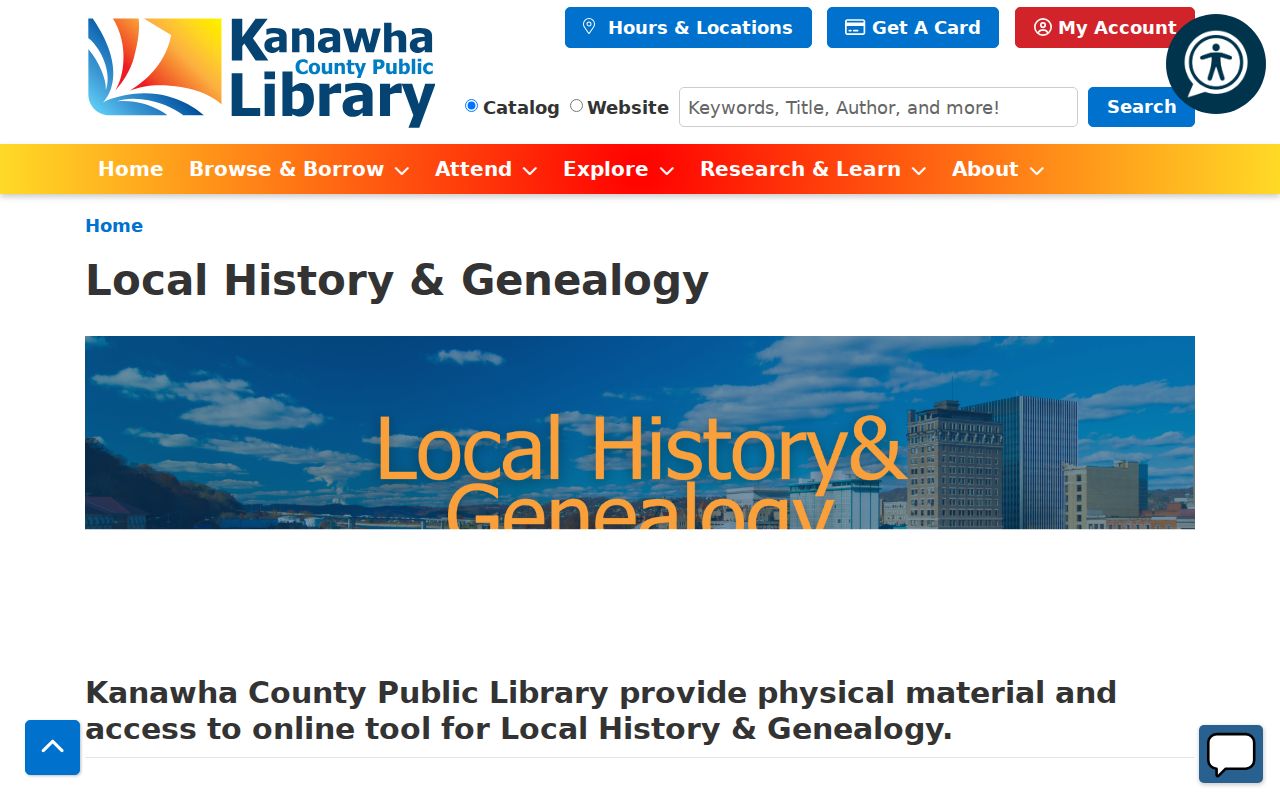
The page joins obituary, newspaper, directory, and archive routes, helping turn a missing online address into a focused desk request.
Charleston Records Did Not Burn
A missing scan is not proof that an original was destroyed. WV Archives states that the Kanawha courthouse never burned and county records were not lost. Charleston has real fire stories involving the 1921 statehouse and 1927 temporary capitol, but those concern state-office material. They must not become a claim that Kanawha deed, marriage, or will books vanished.
Check the Archives holdings list, courthouse index, and record-room books before declaring a gap. A record may be unscanned, listed under another name, or held in a different series. The long deed and grantee-index runs make that extra check worthwhile.
Close Charleston Trails With Life Events
Obituaries, cemetery records, probate files, and vital indexes can explain why a name disappears. KCPL's obituary service may lead to a spouse, parent, church, funeral home, cemetery, or last address. The county fiduciary and probate desk, at 304-357-0125, is the route for wills, estates, settlements, bonds, heirs, and addresses. No current searchable Kanawha probate docket was confirmed.
Charleston City Clerk maintains cemetery and municipal records by request at 501 Virginia Street East. WV Vital Research Records offers historical index and image searching, but an index image is not a certified copy. These endpoints can confirm a family link or approximate move, yet they cannot prove that every named person occupied the house.
Use Charleston Past Households Lawfully
Previous residents research works best as house history, family history, estate research, or a way to understand a changing block. Date every fact and preserve the source. Current owners, directory occupants, heirs, and voter registrants can be different people, even when they share an address or surname.
West Virginia's Address Confidentiality Program can replace a qualifying victim's actual address with a substitute address. Never try to reverse that safeguard by merging a voter, assessor, court, or neighborhood result. Send a protected person to the Secretary of State program and the relevant custodian instead.
Lawful use. Use Charleston previous residents records for legitimate personal research. Never use an address trail to follow, threaten, harass, or harm anyone.